/ SERVICE #26
Security of Sites and Facilities Through the Use of Drones and AI Systems
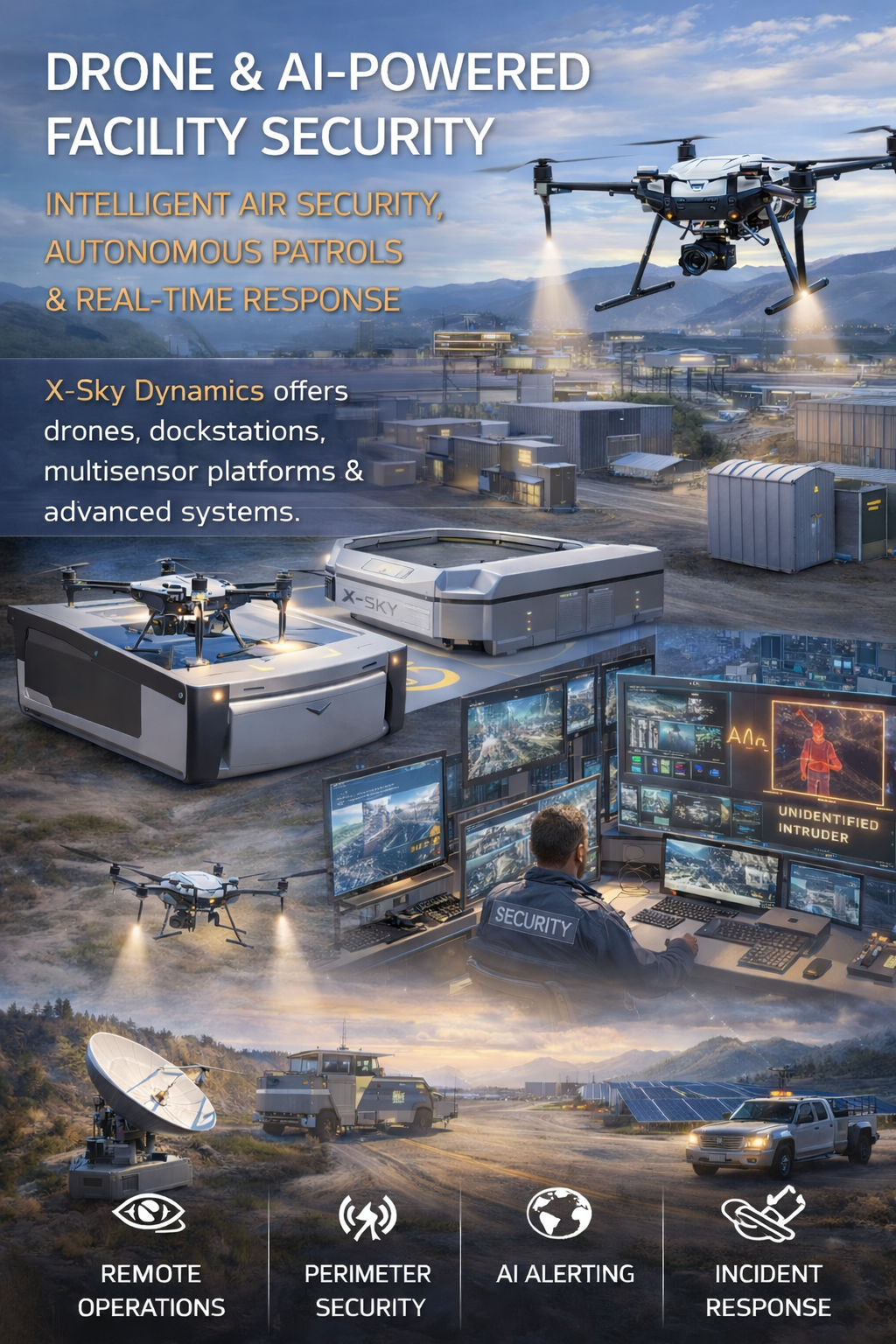
Security of Sites and Facilities Through the Use of Drones and AI Systems Intelligent aerial security, autonomous patrols, and real-time response Dock stations, multisensor platforms, and AI-based analytical solutions. These systems transform drones from a monitoring tool into an active element of the overall security architecture, capable of carrying out autonomous patrols, detecting anomalies, issuing real-time alerts, and supporting decision-making even when responsible personnel are not physically present on site.
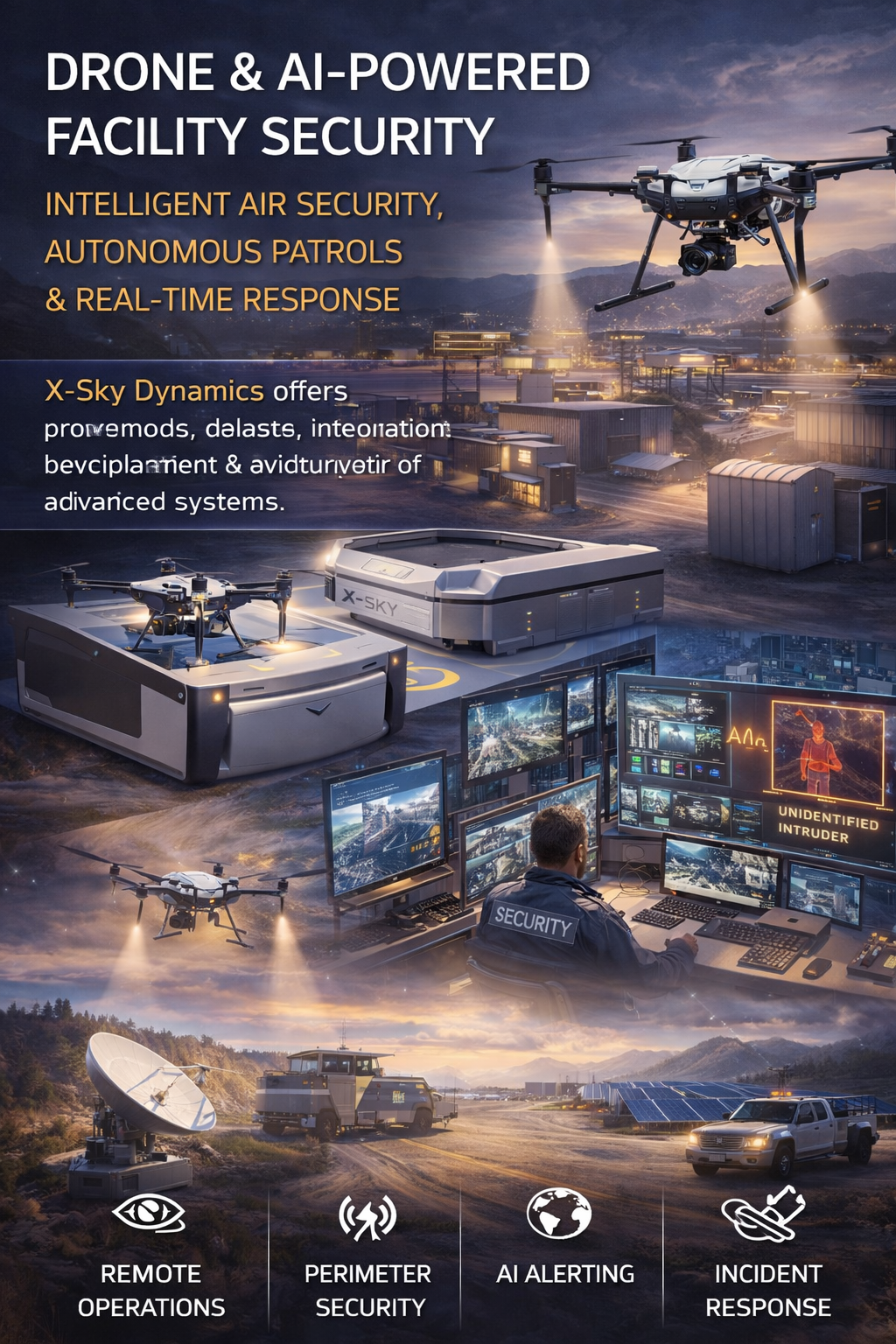
Such solutions are particularly suitable for industrial sites, logistics bases, warehouse complexes, ports, energy infrastructure, construction sites, photovoltaic parks, forest and agricultural areas, critical infrastructure, municipal assets, and facilities with a mixed civil and strategic profile. The core idea is to establish continuous, automated, multi-layer control that combines aerial surveillance, AI analysis, notification, archiving, reporting, and remote control in a single system. Current trends in Drone-in-a-Box solutions are moving precisely toward persistent autonomous patrols, centralized control, integration with external systems, and operational use in public safety, infrastructure security, and government use cases.
What the system consists of
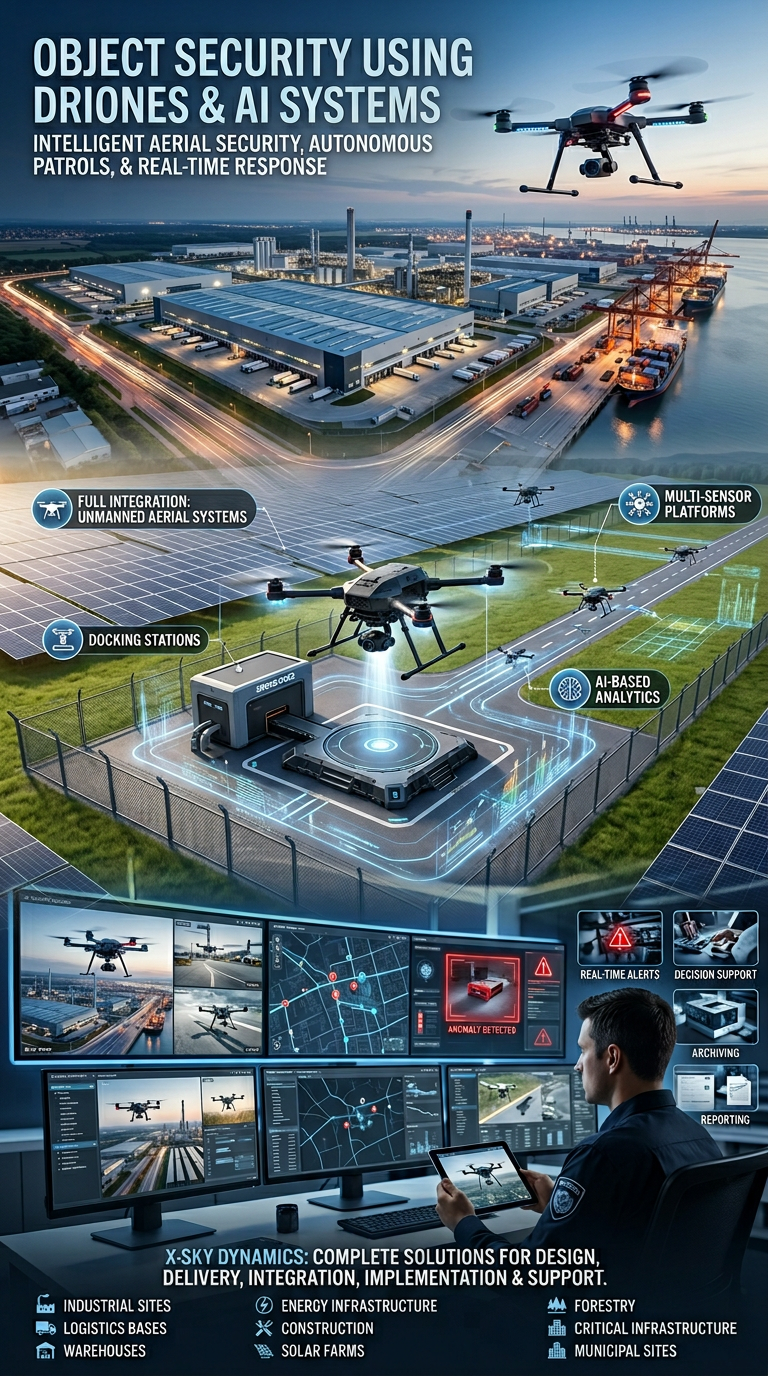
A drone and AI-based security system typically includes:
Dock solutions store, charge, protect, and prepare the drone for missions, allowing launch on schedule, by command, or based on an event trigger. Current-generation systems support 24/7 operation, remote control, cloud management, multi-drone fleet management, and rapid launch after an alarm. X-SKY Dock Y, for example, supports 24/7 remote operations, while Sky Predator Dock 7 for X10 emphasizes 20-second launch readiness, 24/7 mode, and operation “from anywhere in the world.”
- an autonomous Dock station
- a drone with visual, thermal, zoom, and AI capabilities
- software for automated missions
- communication infrastructure
- a command center or web-based control panel
- mobile access for alerts and decision-making
- integration with existing security systems
How such a security system works
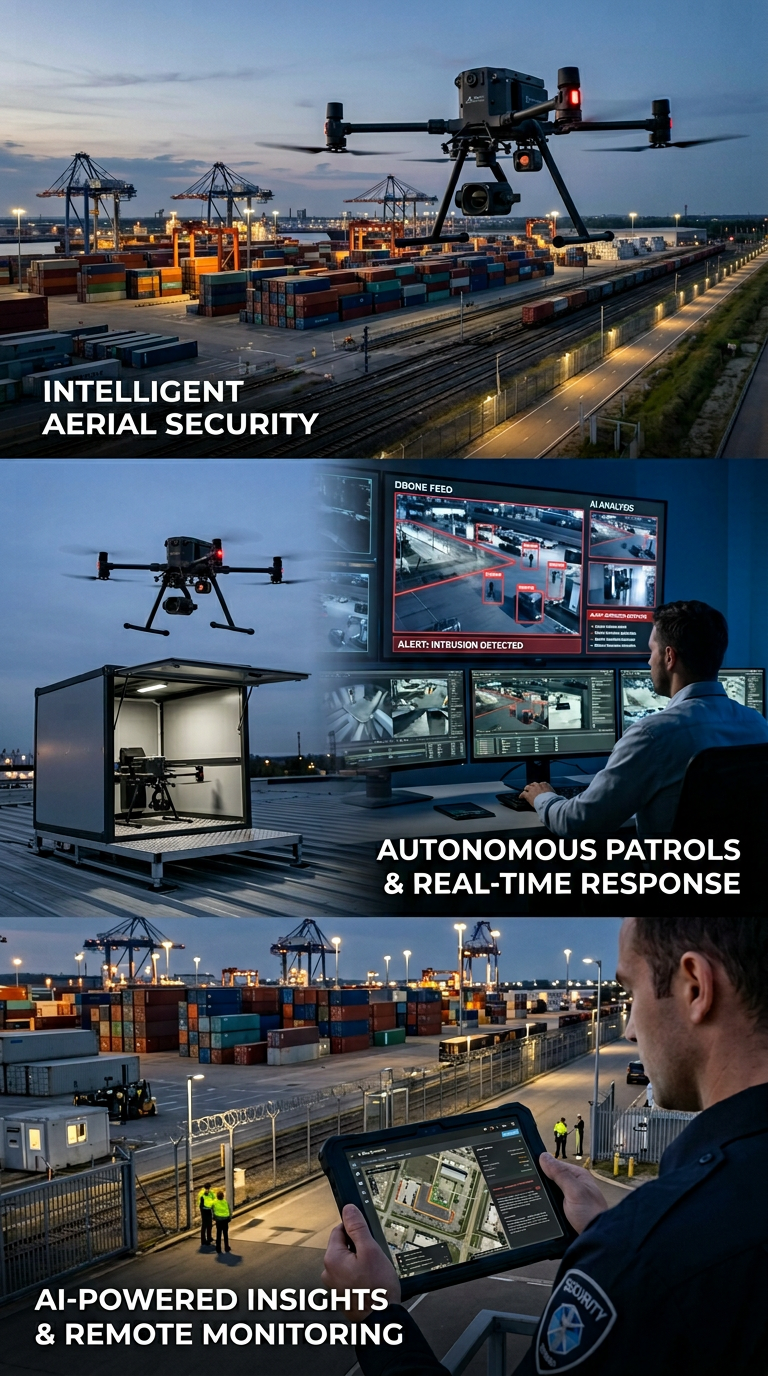
In normal mode, the system performs scheduled autonomous patrols, follows predefined routes and checkpoints, compares the current situation with baseline models, and searches for anomalies. When an event is detected — movement, unauthorized presence, an open perimeter, a thermal anomaly, smoke, fire risk, crowd formation, an unusual vehicle, or a change to an object — the system can automatically trigger an alarm scenario, start a live stream, mark GPS coordinates, record the event, and send a notification to an operator, security team, facility manager, or external institution. Similar scenarios are already being used in real public safety and security deployments with AI analytics, remote alerting, and centralized monitoring of multiple autonomous drones. At a higher level of automation, the system can also operate in an event-driven mode, meaning it can be activated by other sources — ground cameras, radars, motion sensors, fire panels, IoT sensors, SCADA systems, access control, or an operator from a command center. This allows the drone to function not just as a patrol platform, but as an aerial response module that reaches the area of the event within seconds or minutes and provides a visual, thermal, and coordinate-based picture even before ground teams arrive. FlytBase and similar autonomy platforms emphasize precisely these integrations, API connectivity, real-time AI analytics, and the use of autonomous drone apps as part of larger enterprise and public systems.
Main applications
Perimeter security and access control
The systems can patrol fences, entry points, gates, warehouse areas, exterior zones, and key communication corridors, detecting: In such scenarios, the drone significantly reduces the need for constant physical patrols and provides security teams with a faster and broader overview of the perimeter. Real examples of dock-based security operations include automated patrol, verify, and respond missions, including for military base protection.
- unauthorized presence
- intrusion attempts
- suspicious movement
- vehicles outside permitted routes
- violations of access regimes
Protection of remote and hard-to-reach facilities
They are especially useful for:
Where physical security is expensive, slow, or limited, the Dock system can perform regular missions, collect evidentiary information, and raise alerts only when there is a real risk. Practice in infrastructure and public safety projects already shows a clear transition toward repeatable, remote, autonomous drone operations with lower risk for personnel and greater consistency in decision-making.
- photovoltaic parks
- wind turbines
- substations
- pipelines
- dams
- forest areas
- logistics zones
- remote industrial sites
Early fire detection and prevention
Through thermal cameras and AI analysis, the systems can detect:
This is particularly important for forests, agricultural land, industrial sites, warehouses, energy facilities, and solar parks. There are real deployments of autonomous dock solutions for wildfire detection, including across large forest areas, as well as commercial solutions aimed at automated fire prevention in agricultural and large-area environments.
- temperature anomalies
- local hotspot zones
- smoldering points
- smoke and early signs of fire
- overheating of equipment
Traffic and movement control
In urban environments and in large production or logistics facilities, drones can support:
These systems are also suitable for municipal purposes, temporary events, transport corridors, and industrial sites with heavy flows of people and equipment. Platforms such as Skydio already position dock operations for event security, transport corridors, and site readiness.
- real-time traffic monitoring
- detection of blocked routes
- internal site traffic control
- management during mass events
- monitoring of crisis points and incidents
Search, response, and initial assessment
When an event occurs — a missing person, entry into a hazardous zone, fire, accident, incident, flood, or suspicious activity — the drone can be the first resource to reach the area, visualize the situation, and send information to decision-makers. This allows people who are not on shift, managers, crisis staffs, or external institutions to make decisions via app, web interface, or command center without being physically present on site. Real public safety deployments of autonomous drones emphasize exactly this: a shared operational picture, scalable control, and AI-assisted response.
Technologies used
Dock stations
Dock stations are the core of the autonomous system. They provide:
Current systems also include important operational specifications: Dock X, for example, has an IP56 protection rating, an operating temperature range down to -30°C / +50°C according to the official specification, and a maximum operational radius of up to 10 km with compatible platforms.
- secure storage
- automatic charging
- launch readiness
- self-check procedures
- scheduled or event-based operation
- remote access
Multisensor drones
Drones can be equipped with:
Officially, the X Sky Predator Series, for example, includes smart detection and a laser range finder, while the X Sky Locator Enterprise Thermal is positioned for firefighting, SAR, inspection, and night operations.
- RGB cameras
- zoom cameras
- thermal modules
- laser range finders
- RTK positioning
- AI functions for smart detection
AI analytics
The AI component can be used for:
Autonomy platforms such as FlytBase already provide real-time AI analytics, integrations, and an IT security-oriented stack for enterprise deployments.
- human detection
- vehicle classification
- fire and smoke detection
- detection of unusual activity
- comparison against baseline behavior
- automatic alarms and reports
Command centers and applications
The system can be connected to:
This allows different management levels to receive different levels of access — operator, security manager, duty engineer, external consultant, or crisis headquarters.
- a local command center
- mobile devices
- a web dashboard
- cloud platforms
- external security and monitoring systems
What we offer
X-Sky Dynamics can provide this service as a complete solution, including:
This corresponds to the mature enterprise model in drone-in-a-box solutions, where the value lies not only in the hardware, but in the operational system — remote ops, cloud fleet management, automated missions, integrations, and data workflows.
- analysis of the site and its risks
- selection of suitable drones and Dock stations
- design of routes and patrol logic
- integration with existing security systems
- deployment of AI analytics
- configuration of notifications, applications, and escalation rules
- commissioning and operational deployment
- training for operators, dispatchers, and managers
- technical maintenance and upgrades
Reporting, alerts, and decision-making
One of the strongest advantages of such systems is that they do not only “see” — they also report and escalate. Depending on the setup, the system can: This means that even a person who is not on site or not on shift can receive a visual and analytical picture and make an informed real-time decision.
- generate automatic reports
- maintain an archive and event history
- compare missions over time
- send push / e-mail / SMS notifications
- start a live stream for specific users
- allow remote decision-making by an authorized person
Benefits for the client
Federal and infrastructure programs are already encouraging the transition specifically toward repeatable, autonomous, remotely deployable drone operations because they reduce risk for personnel and improve the speed and consistency of decisions.
- fewer physical patrols
- faster arrival to the incident location
- earlier risk detection
- better evidential record
- higher security with lower human risk
- improved coordination between teams
- better traceability and accountability
Application areas
- industrial sites
- logistics parks
- construction sites
- ports
- energy facilities
- photovoltaic parks
- dams and water infrastructure
- forest and agricultural areas
- municipal and government facilities
- critical infrastructure
- facilities with a mixed civil-security profile
Why X-Sky Dynamics
We do not offer simply “a drone for security,” but build a fully integrated system that includes: Our approach is systemic: from risk analysis and solution architecture to real deployment and operational readiness.
- selection of the right platform
- operational design
- AI logic
- notification and escalation
- connection to real security processes
- training and follow-up support
Conclusion
The protection of sites and facilities through drones and AI systems is the next step in modern security. It is a transition from passive observation to autonomous, intelligent, and reactive presence that sees, analyzes, alerts, and supports real-time decision-making. The combination of Dock stations, multisensor drones, AI analytics, applications, and command centers transforms these solutions into a highly effective system for protecting sites, territories, and infrastructure — in industrial, public, and strategic environments alike.
Get in Touch
[ CONTACT US ]